Business Continuity Planning and Disaster Recovery
90% of businesses that lose data in a disaster are forced to shut within 2 years!
One Month’s FREE Support!
we are offering one month's Network Support FREE for new customers who take on an annual contract. Contact Us NOW! To claim this special offer NOW!
FREE IT Audit worth £500
Click here for a FREE, no obligation, IT Network audit worth £500
Virus Alerts
Be sure to peruse the news feed on the latest virus alerts and hoaxes, courtesy of Sophos.
Feedback
We are very interested in what you think. Click here to send us your comments and or your suggestions.
Practical Options in Business Continuity Planning & Disaster Recovery
We have summarised below some of the main practical options that should be considered during your Business Continuity Planning. They are not by any means mutually exclusive, neither is the list comprehensive – there are of course, numerous variations on a theme. A very approximate guide to price ranges of these solutions is also given at the end of this page.
Prevention
Uninterruptible Power Supply (UPS)
In the case that power to the server fails, a UPS will continue to supply power to keep the server going for a period of time. Correctly configured, if the power is shut off for more then a set period, the server will be shut down in a controlled manner (a “graceful shutdown”) to avoid data corruption.
Redundant Array of Inexpensive Disks (RAID)
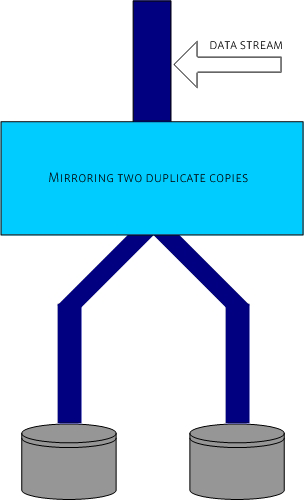
The most likely thing to go wrong on a server is the hard drive. By using a RAID set-up, if one disk fails, linked disks storing distributed copies of the data take over and prevent any downtime.
Backup Solutions
Tape Backup
A separate tape backup for each day/week/month. Tape is generally changed manually and stored in a fireproof safe, preferably a weekly copy is taken off-site.
On-line Backup
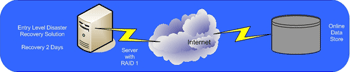
A backup of data taken across a communications line (ADSL, Leased Line) to be stored in a secure environment.
(click for larger image)
Restoration of Data
Backups should be easy, reliable, as automated as possible and done. An important consideration however is what you would do with backed up data if your server was unavailable. It is not possible to just copy files back onto another server and immediately start work again.
Consideration should be given to the reinstatement of server service through repair or replacement before the data can be restored. Generally speaking, it will take at least 24 hours for a new server or spare parts to be delivered and a further 24 hours to set it up and configure ready for restoring the data plus a further day to fully restore systems.
If a delay of two to three days is unacceptable before email and data access is resumed, further options should be considered:
Hosted Services
Most applications can now be provided using an external server which users log on to from wherever they are based. Subject to the stability and security of the hosted environment and power/communications links themselves compared with your main office, this can be a worthwhile consideration
Stored Replacement Equipment
Spare servers and tape drives of a similar (ideally identical) type may be stored off-site for use in emergency. Such equipment can be kept in various stages of readiness so that restoration to a fully-operational system may take as little as 4 hours.
Hot Servers / Live Replication
Where a failover is required resulting in the resumption of service within an hour or less, a system of replication is required whereby every change to a document or every email is copied, replicated, to another server in a secure environment at another site. This solution could be chosen just for email or for all data as well.
Internet Connectivity
In general, the more one pays for an internet connection, the faster the service and better the SLAs will be. An improvement in speed and SLAs normally increases from ADSL to SDSL to a leased line.
A backup line which can take over if the main line fails is better still. Normally a lower specification is used, so an ADSL backup line might be used for a leased line.
A Rough Guide to Pricing
There are a very large number of variables when considering such alternatives, however the following indicative price ranges should provide enough information to decide whether or not options may be worth considering:
| Option | £ From | £ To |
|---|---|---|
| Uninterruptible Power Supply (UPS) | £200 | £1,000 |
| Redundant Array of Inexpensive Disks (RAID) | £500 | £3,000 |
| Tape Backup | £1,200 | £4,000 |
| On-line Backup | £500 | £2,000 |
| Hosted Services | £120 per user pa | Upwards |
| Stored Replacement Equipment | £2,500 | Upwards |
| Hot Servers / Live Replication | £15,000 | Upwards |
Question Checklist:
The following checklist may be useful in deciding whether your current systems are of a suitable standard:
- Is your server in a temperature-controlled environment?
- Is your domain administrator password general knowledge?
- Is your server kept in a "logged-in" state?
- Is your internet connection subject to SLAs?
- Do you have a UPS?
- Is the UPS configured to close down the server in a controlled manner?
- Do you have a backup system?
- Do you check that your backup is done daily?
- Do you regularly keep any data off-site?
- Do you check that data from your backup can actually be restored?